





FAQ – Humidifiers
Why purchase an RPS filter?
What is the purpose of a humidifier?
What is the recommended indoor humidity level for
homes?
How can I determine what the humidity levels are
in my home?
What is a hygrometer / psychrometer?
Why is there condensation on my windows?
Can I use a humidifier in the same room as an air purifier?
Can I use Scents/Fragrances in my portable humidifier?
What is the average life of a wick filter?
Why is the wick filter changing colors or turning brown?
Can I reuse a wick filter?
Can the quality of my water affect the life of my
filter?
How often should I clean my humidifier?
How often should I treat the water in my humidifier?
Why is there a film on the tank of my humidifier?
FAQ – Air Purifiers
What is the purpose of an air purifier?
What are the sources of poor indoor air quality?
What is HEPA?
What is a micron?
What are the different types of air purifier filters?
How often do I replace the filter
in my air purifier?
Why purchase an RPS filter?
RPS manufactures the same high quality filters that either
meet or exceed manufacturers specifications for replacement filters. You can
be confident that an RPS manufactured filter is either equal to, or better in quality
than an Original Equipment Manufacturer (OEM) branded product.
Back to Top
What is the purpose of a humidifier?
In the cool weather season when the furnace is on, the humidity in our homes decreases.
Due to this, we battle dry air, which causes a multitude of problems. Using a humidifier
moistens the dry air, promoting a healthy, comfortable living environment.
Humidification:
- Reduces static electricity.
- Helps soothe dry and itchy skin, throats, and coughs.
- Moistens the respiratory system, allowing for easier breathing and more comfortable
sleep.
- Keeps mucus membranes moist, which is very helpful for asthma sufferers.
- Hydrates woodwork, furniture, and houseplants.
- Helps reduce your energy bills.
Back to Top
What is the recommended indoor humidity level for homes?
According to ASHREA (American Society of Heating, Refrigeration
& Air-Conditioning Engineers) a good range is between 30% and 60% relative humidity.
A wider range, from a low 25% to a high of 80%, can be acceptable for thermal comfort
(your comfort level). It would depend on the type of clothing worn and your level
of physical activity.
Back to Top
How can I determine what the humidity levels are in my home?
You can measure humidity levels with a relative humidity
sensor, usually referred to as a hygrometer or psychrometer.
Back to Top
What is a hygrometer / psychrometer?
A hygrometer or psychrometer is a device that measures
the amount of humidity in a particular area. You can purchase a hygrometer under
the “Other Products” link in our website.
Back to Top
Why is there condensation on my windows?
This means your humidifier is producing too much output for
the area it is humidifying. To resolve this, simply lower the output on the humidifier.
Back to Top
Can I use a humidifier in the same room as an air purifier?
Absolutely!
Back to Top
Can I use Scents/Fragrances in my portable humidifier?
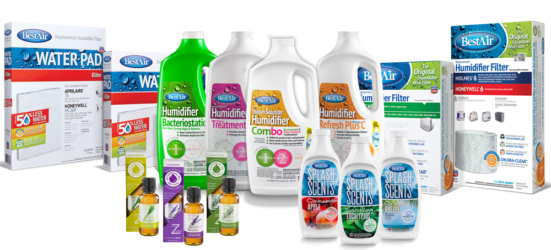
Yes, we recommend using “Splash Scents” Humidifier Fragrances.
Simply add to the water in manually filled evaporative humidifiers. Unlike typical
scented candles or plugin fresheners, the scents work with your humidifier.
Humidity and a refreshing scent are carried throughout the house.
However, Splash Scents Humidifier Fragrances are not
for use in vaporizers or ultrasonic humidifiers.
Back to Top
What is the average life of a wick filter?
This highly depends on usage, and the hardness of your water.
At the minimum, we recommend you replace your filter every 2-4 months.
Back to Top
Why is the wick filter changing colors or turning brown?
As long as the wick is still wet all the way through and
water usage is normal, the wick is still good. Wick filters help to trap impurities
that are in the water. The more impurities and minerals are trapped, the more the
filter will change color.
Back to Top
Can I reuse a wick filter?
No. Wick filters help to trap impurities in the water.
After use, wick filters should be discarded.
Back to Top
Can the quality of my water effect the life of my filter?
Absolutely. The harder your water is, the shorter the life of
the filter. If you have very hard water, your filters will probably need to be changed
more frequently. Also, with hard water, your filter may begin to turn brown.
Back to Top
How often should I clean my humidifier?
Humidifiers should be cleaned weekly. More so, if you have hard water. If not cleaned,
they will not be effective. The following product is recommended:
HumidiClean: This is a cleaner and descaler.
It should be used to clean and prepare your humidifier for efficient operation.
This product removes lime scale and sludge deposits.
This is recommended to clean: Furnace, ultrasonic, Vaporizer and Evaporative humidifiers,
and their filter belts. You can find this under the “Water Treatments”
link in our website.
This is NOT to be used while your unit is running. This is strictly
a cleaner & descaler for your unit, not a treatment you leave in your water.
Back to Top
How often should I treat the water in my humidifier?
Everytime you refill the tank, you should treat the water.
Original BT: This is an odor and bacteriostatic treatment.
We were the first to introduce this product and the first to receive E.P.A. (Environmental
Protection Agency) approval. Original BT controls the buildup of bacteria and algae
in the water tanks of evaporative humidifiers. Original BT also eliminates unpleasant
odors.
Not for use in Ultrasonics or Vaporizing humidifiers.
HumidiTreat: This is a solution specifically formulated
to reduce lime and impurities found in your water. This is especially important
if you have very hard water. It will prolong the life of the filter, and help control
any unpleasant odors.
For use in all evaporative type humidifiers. Not for use in Ultrasonics
or Vaporizing humidifiers.
Back to Top
Why is there a film on the tank of my humidifier?
More than likely, mineral deposits are collecting on the
tank. Clean the humidifier tank with a cleaner/descaler. We highly recommend HumidiClean,
which can be found under the “Water Treatments” link of our website.
Back to Top
What is the purpose of an air purifier?
According to the E.P.A. (Environmental Protection Agency), indoor air may be 2-5
times more polluted than outdoor air. With Americans spending up to 90 percent more
time indoors, indoor air quality is a huge concern.
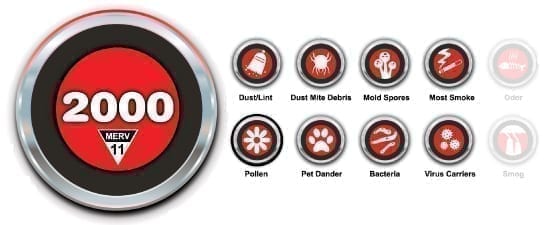
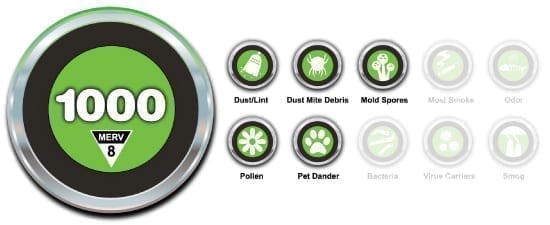
Air purifiers assist to remove impurities in the air we breathe. For example: dust,
pollen, pet dander, smoke, mold spores, and other airborne pollutants.
Most air purifiers use a woven material to capture particles
as they try to pass through. This woven material or air filter, accumulates trapped
particles. As these impurities accumulate in the filter, the filter’s effectiveness
will be reduced by restricted air flow. Be sure to discard the purifier’s
dirty filter and replace with a new filter regularly.
Back to Top
What are the sources of poor indoor air quality?
Some sources of indoor air pollution: tobacco smoke, pollen,
dust, animal dander, mold, mildew, radon, cleaning products, beauty products, building
materials, carpets, furniture, air fresheners, pesticides, etc.
Back to Top
What is HEPA?
HEPA – High Efficiency Particulate Air / Arresting
HEPA is a method of filtering particles out of the air that
are so small they cannot be seen with the naked eye. HEPA law requires it meets
the strict filtration standards of effectively trapping particles as small as 0.3
microns, at least 99.97% of the time.
Back to Top
What is a micron?
A micron is equal to one millionth of a meter, or about a tenth of the size of a
droplet of mist or fog.
It is particulate smaller than the naked eye can see. To give
you another idea for reference, one single strand of hair is approximately 300 microns
in particle size.
Back to Top
What are the different types of air purifier filters?
HEPA Filter – HEPA stands for High Efficiency
Particulate Absorbing /or/ Arresting
This type of air filter can theoretically remove at least 99.97% of dust, pollen,
mold, bacteria and any airborne particles with a size of 0.3 microns. Particles
that are smaller or larger are trapped with even higher efficiency.
A HEPA filter has been tested and you are assured of their filtering quality.
HEPA-Like Filter – a HEPA-“like”
filter may be able to trap some airborne particles, but does not do so at the rating
of a true HEPA filter.
Carbon Filter – a carbon filter removes larger
particles and eliminates odors in the air. A carbon filter will remove almost any
type of odor.
Washable Foam – a washable
foam filter removes larger particles in the air and is designed to be cleaned &
reused.
Back to Top
How often do I replace the filter in my air purifier?
A HEPA filter should be replaced every 12 months or so, depending on how often you
use your air purifier.
A carbon filter should be replaced every 3 months, again depending on your usage.
If you are unsure, refer to the manufacturer’s user manual.
Back to Top
|